Braid, Monofilament and Leader Selection
Choose line for the job, not by habit
There is no single best fishing line. Braid, monofilament and leader materials solve different problems, and the useful question is not “which one wins?” It is “what does this outfit need to do?”
Start with the fishing method, target size, terrain, depth, current and the way the line will be handled. A lure outfit casting repeatedly from a small boat has different needs from a downrigger, a deep-jigging outfit or a bait rod sitting in a holder. The reel’s capacity, drag range and line-lay quality also matter.
A balanced system has three parts:
- a main line that provides the required capacity, handling and feedback
- a leader that deals with abrasion, presentation and terminal-tackle needs
- knots or connections that pass cleanly, retain adequate strength and can be tied reliably on the water

Line labels are useful, but the printed rating does not tell the whole story across every brand. Diameter, construction and real breaking behaviour vary. Check the manufacturer’s specifications and spool by diameter and application, not only by a printed strength number.
What braid does well
Braid has very low stretch for its length and is thin for a given nominal strength. That can improve bite detection, lure control and depth contact. Its smaller diameter can also reduce water resistance, which is valuable when jigging, fishing deeper water or trying to keep a lure or bait under control in current.
On one fast-drifting offshore boat I moved to 15 kg braid on 4000-size reels while still fishing 250 gram jigs. The thinner line reached the bottom more directly and the lighter outfit made a long jigging session easier. That was a solution to one boat, depth and current problem, not a universal jigging formula. Fish size, drag setting and terrain still set the safe lower limit.
Colour-change braid is also useful as a repeatable depth or distance reference. Treat the colour changes as a reference, not an exact depth reading. Current, boat speed and line angle can leave the lure much shallower than the amount of line paid out.
Braid also offers good reel capacity. This is useful on compact reels and offshore outfits where a long run is possible. Its lack of stretch, however, transfers sudden loads to knots, hooks, rods and anglers. It can be unforgiving if the drag is too tight, the rod has little cushioning or the connection is poorly tied.
Braid needs careful handling. It can cut fingers under load, wrap around guides or hands, and bury into a loosely packed spool. Never pull a snag by wrapping braid around your hand or the rod. Point the rod safely, protect yourself and use a suitable line-breaking method.

Where monofilament still earns its place
Nylon monofilament stretches more than braid. That stretch can absorb shock from a fast fish, a sudden boat movement or an angler who is still learning to manage drag pressure. Mono is also simple to handle, economical to replace and often more tolerant of small handling mistakes.
For trolling, live baiting and some bait-fishing systems, a mono main line can provide useful cushioning. It can also be easier to clear when several lines cross. Its larger diameter creates more water resistance and reduces reel capacity compared with braid of similar stated strength, so it may be less suitable when depth and current control are the main priorities.
Mono ages. Sunlight, heat, repeated stretching, nicks and long storage under pressure all matter. Run the first few metres through your fingers before a trip and replace line that feels rough, flattened, cloudy or unusually stiff. Do not rely on a spool simply because it has not broken yet.
Why most braid outfits still need a leader
A leader gives the terminal end qualities that braid may lack. It can add abrasion resistance, controlled stretch, stiffness or a less conspicuous presentation. It also provides a sacrificial section that can be replaced without removing a large amount of main line.
Nylon monofilament leader is generally supple, absorbs shock and often knots easily. Fluorocarbon leader is denser and usually stiffer, with useful abrasion characteristics in many applications. Neither is automatically best. Manufacturer guidance from Daiwa and Shimano both frames the choice around presentation, abrasion, stiffness, stretch and the fishing situation rather than a universal rule.
For surface presentations or baits that need freedom, a supple nylon leader may behave more naturally. Around rough structure or when a stiffer connection helps prevent tangles, fluorocarbon may suit. In very clear water, some anglers prefer fluorocarbon, but line diameter, lure action and the fish’s behaviour remain part of the result.
Leader material must still be inspected. Fluorocarbon is not immune to damage, and a hard kink or scraped section should be cut out.

Match line strength to the whole outfit
Choose the main line and leader together with the rod, reel, drag, hooks and likely terrain. Begin with these questions:
- What fish size is realistic, not merely possible?
- Is the fish likely to reach reef, timber, pylons or sharp shell?
- Will the line be cast, jigged, trolled or held near vertically?
- How much capacity does the reel hold at the actual line diameter?
- What drag pressure can the reel and rod manage smoothly?
- Will knots pass through guides repeatedly?
- Can the angler tie and test the connection reliably?
Heavy line cannot compensate for an unsuitable rod, locked drag or poor knot. Light line is not automatically more sporting if it prolongs a fight unnecessarily or leaves tackle attached to a fish. Use enough margin for the task and the likely abrasion, then set the drag to suit the complete outfit.
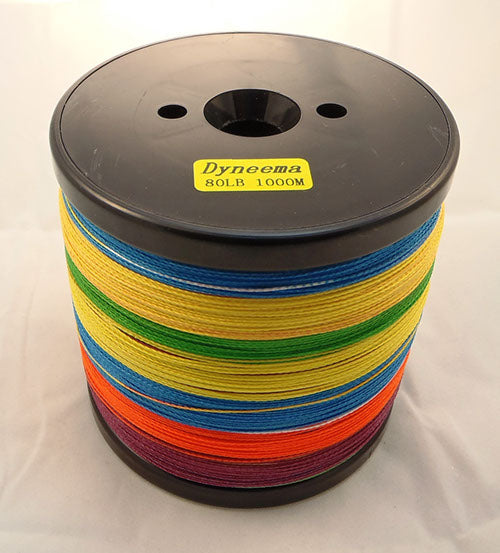
The Downrigger Shop braid page lists the breaking strain, length and colour format for each spool. Match the actual spool to the reel’s capacity and the job.
Match line behaviour to common methods
Lure casting
Braid is popular because it casts well, gives direct contact and helps work many lure styles. Match diameter to the reel and lure weight, and use a leader length that casts cleanly without putting a bulky knot on the spool. If wind knots appear, check spool fill, line twist, guide condition and casting technique before assuming a heavier line is the only answer. If guide damage may be the cause, use our rod-guide inspection before changing line.
Soft plastics
Low-stretch braid helps an angler feel the lure and detect changes in line tension. A leader adds abrasion resistance and a controlled terminal section. The useful combination depends on depth, current, bottom type, jighead weight and fish size. There is no universal snapper formula. The goal is a controlled line angle and a lure that can be worked through the intended part of the water column.
Jigging
Diameter matters because current acting on the line creates a belly and delays the jig. Thinner braid can improve contact, but only if it retains the strength and durability required for the target and terrain. Check the first metres frequently because repeated jigging can expose line and leader to guides, knots and fish contact.
Trolling
Mono offers shock absorption and straightforward handling, while braid offers capacity and low stretch. Either can work in a properly designed system. With braid, allow for cushioning through the rod, drag and leader. With mono, allow for greater water resistance and stretch when setting lure position and interpreting a strike.
Downrigging
The fishing line from the rod is separate from the downrigger line. Its best material depends on bait, target, release method and how the rod is loaded. Braid can require a rubber-band interface or a clip setting that avoids concentrated jaw pressure. Mono may grip differently. Test the exact line and release-clip setup at low speed before sending it to fishing depth.
Make the connection the part you trust most
A strong line system can fail at a poorly tied knot. Use a connection suited to the difference in diameter and stiffness. For braid-to-leader connections, compact knots are helpful when they must pass through guides; simpler knots may be preferable if they can be tied more consistently on a moving boat.
Whatever knot you choose, the practical test is whether you can tie it correctly and repeat it with the line in your own tackle box. On a moving boat, a simple connection tied well is safer than a fashionable knot tied badly. Before relying on it:
- learn it from a reliable technical source
- tie it the same way every time
- lubricate and tighten it as the knot requires
- inspect for crossed or damaged wraps
- trim tags safely without cutting the standing line
- pull-test it firmly before fishing
Practise with the exact braid and leader combination. A knot that behaves well in one diameter pair may be difficult in another. Carry reading glasses, cutters and a small knot tool if they make your results more repeatable.
Spooling and maintenance prevent many “line problems”
Check reel capacity from the manufacturer and allow for the true diameter of the chosen line. Braid needs to be packed firmly enough that later turns cannot cut into loose layers. A suitable backing or manufacturer-approved spool attachment prevents the whole load from slipping around a smooth arbor.
Do not overfill. Leave the clearance recommended for the reel and line. After a trip, rinse the outfit as its manufacturer directs, inspect the working end and remove damaged line. Reverse or replace braid only when its condition and construction make that appropriate. Replace leaders when they are nicked, milky, kinked or repeatedly retied too short.

A practical starting decision
If depth contact, sensitivity and capacity dominate, start by evaluating braid with a suitable leader. If shock absorption, simple handling and economical replacement dominate, consider mono main line. Then tune diameter, leader material and connection to the target, terrain and reel.
The best system is the one you can spool correctly, tie reliably, inspect quickly and fish within its limits. Choose the whole line system, not a fashionable material in isolation.