How to Catch Kingfish in NSW: Find the Bait, Then Choose the Method
Kingfish can make a simple day look complicated. They might be pushing tiny bait on the surface, sitting halfway down beside a bait school, or holding deep enough that a cast lure never reaches them. The answer is not to keep throwing the same thing harder. Find the bait, work out where the fish are, then use the method that can be presented properly at that depth.
The first thing we look for is bait. Kingfish are mobile, and a spot that fired yesterday can be quiet today. Bait gives them a reason to stay. It also tells you something about lure size, likely depth and whether the fish are hunting on top or below the activity. Structure matters, but structure without bait or decent marks is only part of the picture.
As of 25 August 2026, yellowtail kingfish in NSW have a minimum legal length of 65 cm and a daily bag limit of 5, but always check the current NSW rules before fishing.
This guide covers the decisions that matter on the water. The detailed knots and rigging steps sit in the linked method pages, and the broader Fishing How-To Guides are there when you want to go further.

Start with bait, not a favourite lure
Bait can show itself in several ways. It might be a nervous patch on the surface, birds repeatedly dipping in one area, a tight cloud on the sounder, or scattered schools sitting along an edge. Slow down and watch before charging in. The useful questions are: how big is the bait, how deep is it, which way is it moving, and are larger fish close to it?
A visible school is easy to ruin with poor boat position. Driving straight through it may split the bait, push the kingfish down and annoy every other boat trying to fish it. When we find a visible school, we work out which way it is moving and put the boat ahead of it. That leaves room to cast beyond the fish and bring the lure back through their path instead of chasing them from behind.
Match the scale of the presentation to what is happening. If kingfish are feeding on very small bait, a compact lure often makes more sense than the biggest stickbait in the box. If the bait is deep and the surface is quiet, a surface lure may be the wrong tool even if it caught fish last week. The point is not that small always wins. The point is to notice the food in front of the fish and make a sensible first choice.
Let the sounder tell you where to fish
We normally start with the sounder, not the lure box. First establish the bottom depth and the shape of the ground. Then look for bait and for stronger returns beside, above or below it. A single mark is not automatic proof of a kingfish, but a repeatable pattern of bait and larger returns gives you something worth fishing.

The important number is the depth of the marks, not just the depth under the boat. Fish showing at 20 metres in 50 metres of water need a presentation through 20 metres. Dropping everything to the bottom wastes time and may put tackle into structure. The sounder guide explains how depth, bottom, structure, bait and fish returns fit together.
Pay attention to what happens on the next pass. Do the bait and larger marks stay at the same level? Are they moving up or down? Does the picture disappear when the boat turns or when another boat runs through? A repeatable depth points towards jigging, a weighted bait or controlled-depth trolling. Marks that rise quickly towards the surface may call for a cast presentation instead.
Choose the method that reaches the fish cleanly
There is no single best kingfish method. The best method for the next pass is the one that reaches the fish, suits the conditions and can be repeated without tangles or dangerous boat work. A simple decision path keeps the tackle choice honest:
- Fish feeding on top: cast a lure that is close to the bait size and place it ahead of the moving school.
- Fish marking under the boat: jig through the marked band if the drift lets the lure stay close enough to vertical.
- Fish holding with a bait school: try a healthy live bait that can be kept at the same depth.
- Fish or bait holding at a repeatable level while the boat can make a steady pass: consider a downrigger.
- No bait and no useful marks: move and look again instead of forcing a technique into empty water.
If traffic, wind, current or the position of the boat makes a method unsafe, stop and reset. Kingfish are not worth a line around the propeller, a downrigger weight swinging across the cockpit or a close pass beside another boat. Change the angle, wait for room or choose another option.
Live bait: lively beats fancy
Live bait is at its best when kingfish are holding near a bait source or ignoring artificials that have been presented properly. It is not a magic answer. A tired bait, a hook that overpowers it or a rig that spins behind the boat can look worse than a simple lure.

With live yellowtail, we look for a light-coloured bait that is swimming strongly and has not been damaged around the mouth. Darker colour can be a sign that the bait is stressed, and a torn mouth usually gets worse once the bait is deployed. The healthiest bait in the tank is worth more than the largest one.
We use a small net, handle it as little as possible and avoid squeezing it. Wet, gentle handling and a quick transfer help keep the bait swimming. Watch it beside the boat before sending it down. If it rolls, spins or struggles there, fix the rig or change the bait before making the pass.
Choose a hook large enough to set cleanly, but not so large that it controls the bait. A small rubber-band bridle can cushion the direct shock of low-stretch braid and makes it possible to return an unused bait to the tank without a hook wound. The live-bait rigging guide shows that setup, while the squid guide covers another useful bait option.
Jigging and surface lures
Jigging fits fish that are below the boat and a drift that lets the lure pass through them. For vertical jigging, we choose the lightest jig that will reach the marked depth and stay there in the current. Lighter is comfortable and often feels better, but only while it remains controllable. A jig that never reaches the fish is too light for that drift.

If the line is sweeping well away from the boat, we go heavier or reset the drift. Thinner braid creates less resistance in the water and can help a jig sink, but line choice still has to suit the outfit, structure and pressure required. Do not solve every line-angle problem with a heavier jig if a better boat position will do the job.
Work the depth where the fish are showing. That might mean a short lift-and-wind sequence through a ten-metre band rather than winding from the bottom to the surface every time. We also use a short pause after a run of lifts because a kingfish will sometimes eat as the jig changes pace. It is a useful variation, not a guaranteed trigger.
The beginner jigging guide goes deeper into the technique. If 100 grams suits the depth, current and rod in hand, the 100 g knife-jig pack is a practical option. Do not choose it because the number looks right on a product page. Choose it because it keeps contact with the fish zone on the day. The assist-hook guide covers hook clearance, cord wear and connections on metal jigs.
Surface lures need a different boat position. Get ahead of the school, cast past its path and bring the lure into the feeding zone. Keep the presentation close to the size of the bait and leave enough room for birds, other anglers and sudden direction changes. If the school goes down, stop blind casting and use the sounder to find where it settled. For the retrieve itself, see our saltwater popper guide.
When a downrigger earns its place
We reach for a downrigger when bait or fish are holding at a repeatable depth and a controlled pass is possible. Its value is depth control. The weight carries the release down while the bait or lure swims behind it, so the presentation can spend more time beside mid-water marks instead of somewhere above them.
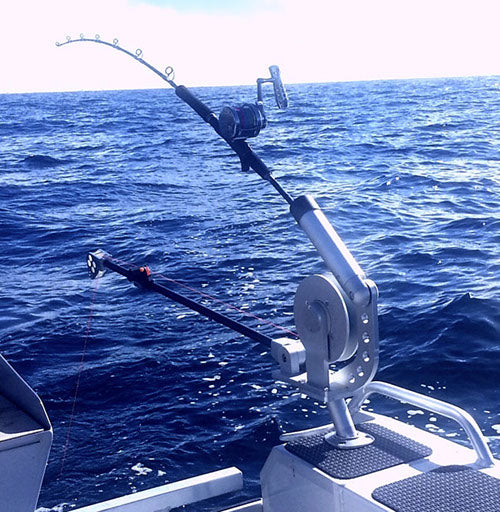
Start by making sure the bait or lure swims cleanly beside the boat. Choose a path with room to turn, lower the weight under control and keep the cable, braid and fishing line clear of the propeller. Current creates blowback, so the counter is a guide rather than proof that the weight is directly under the boat. Watch line angle and the sounder together.
A downrigger is not a reason to keep circling a blank screen. If a pass misses the bait or produces no useful marks, correct the line. If repeated passes show nothing, move and look elsewhere. The lesson from a quiet pass is not that downrigging failed. It is that depth control only helps when the boat is putting a good presentation near fish.
The downrigging guide explains the full setup and sequence. For boats where the method fits, the Downrigger Shop downrigger is the relevant equipment option. The reason to use one is a repeatable depth problem, not the idea that every kingfish trip needs extra gear.
Match the whole outfit
A kingfish outfit is a system. Rod, reel, braid or monofilament, leader, knots, hooks and lure weight all need to work together. A powerful rod does not fix a reel with too little line. A heavy leader does not fix a poor connection. A large jig does not suit every rod simply because kingfish can grow big.
Begin with the method. A cast lure needs a rod that loads and releases that lure cleanly. A jig outfit needs to work the chosen weight without exhausting the angler. A live-bait or downrigger outfit needs enough control for the structure and enough line capacity for a strong first run. Comfort matters because an outfit that is unpleasant to use gets less time in the water and poorer technique as the day goes on.
Main line diameter changes how a jig sinks and how much drag the current puts on it. Leader choice changes abrasion resistance, knot size and the way the connection passes through the guides. Test the complete connection under steady load before the trip. Check it again after a fish, a snag or contact with the boat. Never wrap braid around a bare hand to break a snag or control a fish.
Use enough drag and rod pressure to turn the fish before it reaches structure, but stay inside the weakest part of the system. Build pressure smoothly rather than locking everything down in panic. In open water there may be room to use lighter gear. Close to hard structure, the same outfit may give the fish too much advantage. Match the tackle to the actual water, not to a single number copied from somebody else's setup.
Fish on the screen, nothing on the hook
Our approach when fish show but do not bite is to check the presentation first, then change one useful thing at a time. A sounder mark tells you that something passed through the beam. It does not prove the species, the mood of the fish or the reason a lure was ignored.
- Confirm the depth. Did the bait or lure actually pass through the marks?
- Check that the presentation is working. Is the bait lively, the jig in contact and the lure free of fouling?
- Look at line angle and boat track. A clean reset may fix more than a tackle change.
- Compare the presentation with the bait. Change size or profile if there is a clear mismatch.
- Change pace. A pause, shorter jigging stroke or different trolling speed can be tested without rebuilding the outfit.
- Move when the picture disappears. A fresh bait school is better than an old waypoint with no life on it.
Avoid inventing a grand theory after one refusal. Tide, light, current, boat traffic and fishing pressure may all matter, but the screen rarely tells you which one caused the result. Keep the diagnosis practical. Depth, presentation, bait condition and boat position are things an angler can observe and change immediately.
A simple kingfish plan
A good plan does not need twelve rods. Take one or two outfits that cover genuinely different depths, a small set of presentations, and the bait gear you can use properly. Check weather and sea conditions before heading offshore, make sure the boat and crew are up to the trip, and leave room to change plans when the water says no.
On arrival, find bait and note its depth. Look for larger marks and make one clean presentation through them. If the fish are on top, get ahead and cast. If they are under the boat, jig the marked band. If they hold beside bait at a repeatable depth, swim a good live bait or make a controlled downrigger pass. Keep the method tied to what is happening, not to what you hoped would happen.
When a kingfish is landed, make the keep-or-release decision promptly and handle it with care. Measure any fish you intend to keep against the current rules. Chill retained fish quickly, look after the flesh and take only what will be used. The existing kingfish cooking guide is there when the catch reaches the kitchen.
The core of kingfish fishing is straightforward: bait, depth, boat position and a presentation that behaves properly. Get those four things working together and every lure, live bait or downrigger pass has a clear purpose. If one of them is wrong, fix it before reaching for more tackle.
Explore Sydney’s fishing marks
The Sydney offshore fishing marks guide includes fish species, depths and links to Andrew’s trip reports. Browse the marks and open any that interest you on the map.
Put the plan to work at Long Reef: Our Long Reef boat-fishing guide explains the local ground, changing current and decisions behind several very different sessions.