How to: Get Started with Jigging for Kingfish in Australia
Jigging is one of the most effective ways to target kingfish and other offshore predators around reefs, wrecks and pinnacles. The basic idea is simple: find the fish, get a metal jig into their depth band, then work it through the strike zone like a fleeing or injured baitfish.
This guide is based on decades of fishing experience from Downrigger Shop's Andrew Hestelow, including the material from his original magazine article on jigging, updated with a more practical approach for anglers getting started today.
Quick answer: Start with balanced tackle you can work for repeated drops, use a jig heavy enough to reach the fish without being swept away, watch the sounder and line angle, and spend your effort jigging where the fish are rather than blindly working the entire water column.
What Is Jigging?
Boat-based vertical jigging uses a dense metal lure that can be dropped quickly to fish holding deep in the water column. Once it reaches the target depth, the angler combines rod movement and reel turns to make the jig dart, flash, pause and accelerate. To a kingfish or other predator, that movement can look like a baitfish making a desperate escape.
Jigging is not new. Andrew was effectively jigging for Spanish mackerel with metal lures off Hat Head in the late 1970s, before the technique carried the modern name and specialised tackle. The equipment has changed enormously since then. The core idea has not.
1. Find Fish Before You Start Jigging
The sounder is one of the most valuable pieces of jigging tackle on the boat. Reefs, wrecks, pinnacles and drop-offs concentrate bait. Predators then gather around that bait, sometimes close to the bottom and sometimes suspended well above it.
Do not assume that a 60 metre reef means you must bounce the jig off 60 metres. If the kingfish are stacked from 35 to 45 metres, your job is to put the lure through 35 to 45 metres as often as possible.


Colour-coded braid is helpful because it gives you a repeatable depth reference. If a hookup comes at a particular depth, you can send the next drop back to the same band instead of starting from scratch.
2. Choose Jig Weight for the Conditions
There is no honest chart that says a particular depth always requires one particular jig weight. The right jig is the one that reaches the strike zone efficiently and lets you maintain control.
Depth matters, but so do current, wind, boat drift, braid diameter and jig shape. A 100 g jig can be excellent in 40 to 60 metres on one day and frustrating in the same water on another if the current is running hard.
| What you see | What to do |
|---|---|
| Jig drops cleanly and stays fairly vertical | Your weight is probably in the useful range. |
| Line quickly angles well away from the boat | Try a heavier jig, thinner line where appropriate, or improve boat positioning. |
| Jig takes too long to reach suspended fish | Increase weight or choose a faster-sinking profile. |
| Conditions are calm and the jig is easy to control | A lighter jig can reduce fatigue and change the action or fall. |
Our 100 g knife jigs have been a particularly useful size around moderate-depth Sydney reefs and wrecks when conditions allow. In deeper water or stronger current, go heavier rather than clinging to a favourite number.
3. Use a Balanced Jigging Outfit
One lesson from Andrew's original article still matters enormously: a theoretically powerful outfit is no use if it exhausts you so quickly that you stop jigging effectively.
Modern kingfish tackle spans a broad range. The right outfit depends on jig weight, fish size, depth and how unforgiving the structure is. For general boat-based jigging, look for a purpose-built rod rated for the jigs and line class you intend to use, paired with a saltwater reel with enough line capacity and a smooth drag.
Current specialist kingfish setups can be much heavier than the tackle Andrew preferred in his older article, particularly around rough structure and very large fish. That is why this updated guide does not prescribe one reel size or line strength for everyone. Match the whole system to the fishery, and make sure the rod's jig rating actually suits the lure you are working.


Spin or overhead?
Both work. Spinning tackle is familiar to many anglers and makes it easy to move between jigging and other lure styles. Overhead tackle keeps the spool in line with the rod and can be an excellent vertical jigging system. Choose the format you can use smoothly and confidently rather than treating one as mandatory.
Braid and leader
Braid is well suited to jigging because its low stretch gives direct contact with the jig and a relatively thin diameter for its strength helps it cut through the water. A leader adds abrasion resistance and some shock absorption between braid and lure. Leader material and strength should reflect the fish, structure and tackle class you are using.
Prepare your knots and rigs properly before leaving home. Offshore in a moving boat is a poor place to discover that you cannot tie your preferred connection quickly and reliably.
4. Rig the Jig Simply and Safely
A single assist hook at the head of the jig is a simple arrangement and is what we supply on our 100 g jigs. It keeps the hook near a common strike area and avoids having an unnecessary treble hook swinging around when a fish reaches the boat. For a closer look at hook clearance, cord length and connections, see our assist-hook rigging guide.
Check the assist cord, hook point, split rings and leader after fish, snags and toothy encounters. Barracouta, mackerel, sharks and leatherjackets can all damage terminal tackle. Replacing a suspect connection is much cheaper than losing the next good fish.

5. Control the Drift and Your Line Angle
Vertical jigging works best when the boat and jig are moving in a way that keeps you connected to the lure. Wind and current push the boat while the jig is sinking, which can create a large line angle and pull the lure away from the fish.
Plan the drift so you pass over the structure or marks, not after you have already drifted beyond them. Where safe and appropriate, boat control can be used to slow the rate at which the line angles away. The exact method depends on the boat, current, wind and sea state.

6. Learn a Repeatable Jigging Rhythm
You do not need an elaborate routine to catch your first fish. Start with a coordinated lift of the rod and turn of the reel handle, then lower the rod while taking up the line so the jig can dart and change direction without leaving large amounts of uncontrolled slack.
Once that basic rhythm feels natural, vary it. Speed up. Slow down. Use shorter strokes. Add a pause. Let the jig fall. Different jig shapes behave differently, and fish do not always want the same presentation from one hour to the next.
A useful beginner sequence is:
- Mark the fish and note their depth.
- Drop the jig slightly below the target band where practical.
- Engage the reel and work the jig upward through the fish.
- Keep going several metres above the marks.
- Drop back through the zone and repeat.
- Change cadence, colour or jig weight if fish continue to mark without striking.
7. Fight the Fish, Not the Tackle
A smooth drag and a rod with enough working curve help absorb the shock of a hard-fighting fish. Set the drag for the line, leader, hooks and structure you are fishing rather than simply winding it as tight as possible.
Kingfish can punish weak links quickly, especially around shallow or hard structure. Keep steady pressure, avoid extreme rod angles and be ready for another surge near the boat. How aggressively you can fight a fish depends on the environment. A kingfish hooked over clean deep water gives you different options from one hooked beside a reef edge or wreck.

More 100 g jigging results from the archives
These older customer and Downrigger Shop photos are from earlier generations of our 100 g jig range. They are included here because they show how broadly the 100 g weight class has worked around Sydney kingfish grounds over the years, without implying that every fish below was caught on today's exact jig shape.
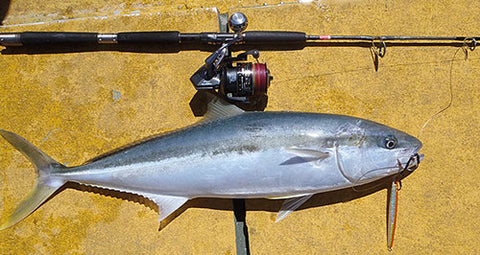


8. 100 g Jigs Catch More Than Kingfish
One reason metal jigging is so addictive is that you do not always know what will eat the lure. A 100 g jig worked around offshore bait and structure can attract a wide range of predators.


9. Common Jigging Mistakes
Using a jig that is too light for the drift
If the lure never reaches the fish, colour and technique are irrelevant. Watch the line angle and go heavier when necessary.
Fishing the bottom when the fish are suspended
Read the sounder. Working empty water wastes energy and increases the chance of snagging.
Using tackle that is exhausting to work
Heavy gear has a place, but the outfit should match the fishery and jig. A balanced system that you can fish effectively for repeated drops is better than excess weight for its own sake.
Changing colour before fixing depth and presentation
Colour can matter, but first make sure the lure is reaching the fish and moving properly. Then experiment with colour when you know the fundamentals are right.
Ignoring damaged terminal tackle
Inspect leader, assist cord, hook and rings regularly. Teeth, reef contact and previous fights can leave damage that only becomes obvious when the next fish loads the tackle.
Staying on an empty mark
Jigging is much more productive when you use the electronics and keep looking for bait and predators. Structure without life is just structure.

10. A Simple First Jigging Session
If you are starting from scratch, keep the first trip simple:
- Choose a known reef, wreck or other offshore structure and fish suitable weather and sea conditions.
- Use the sounder to locate bait and larger fish before dropping.
- Start with a jig weight that comfortably reaches the marked depth. Around moderate Sydney depths, 100 g is often a useful starting point when current allows.
- Position the boat for a controlled drift across the marks.
- Drop to the target zone, work the jig through it, then repeat.
- Change weight first if you cannot maintain depth or contact.
- Once presentation is working, experiment with speed, pauses and colour.
- When you hook up, note the depth and repeat the successful pass.
Frequently Asked Questions
Are 100 g jigs good for kingfish?
Yes. They are a proven and useful size for kingfish when the depth and current suit them. Downrigger Shop has used 100 g jigs around Sydney reefs and wrecks for many years. Heavier jigs are more appropriate when current, drift or depth prevents a 100 g jig reaching the strike zone effectively.
What depth is a 100 g jig suitable for?
There is no fixed maximum or minimum depth. Much of our successful 100 g fishing has been in roughly 40 to 60 metres, but current, wind, boat drift, line diameter and jig shape can make the same weight behave very differently from one day to another.
Should I use a spinning or overhead reel for jigging?
Both are effective. Choose a saltwater reel that balances the rod, carries suitable line and has a reliable drag. Familiarity and comfort matter because jigging involves repeated drops and retrieves.
Do jig colours matter?
They can. Andrew has seen preferences during side-by-side fishing, but colour should come after the basics. First make sure the jig is at the right depth and has a useful presentation. If fish are marking without striking, colour is one of the variables worth changing.
Do I need to jig all the way from the bottom to the boat?
No. If your sounder shows fish in a defined depth band, concentrate your effort around that zone. That saves energy and keeps the lure in productive water more often.
Ready to Try It?
Jigging is physical, active fishing, but it does not need to be complicated. Find the fish, choose enough jig weight to stay connected, use tackle you can work comfortably and keep the lure passing through the strike zone. The rest comes with time on the water.
If 100 g suits the water you fish, see our 10-pack of 100 g knife jigs. It includes two each of five colours with assist hooks fitted and Australian delivery included. For a real-world look at the current jig design being tested on Sydney kingfish, read Jiggin' the Disco Biscuit. For a boat-based example of applying small metal jigs to a feeding school, see our bonito metal-lure guide.
From the archives
Want to see where this guide began? Download Andrew Hestelow's original magazine article, Jigging: Not Black Magic, Just Hard Work. Some tackle references in the original article are historical, so use the updated guide above for current general recommendations.
