Mackerel Trolling Guide for Australian Waters
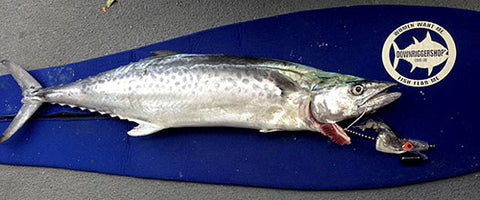
Start with Spanish and spotted mackerel
Spanish and spotted mackerel reward a simple plan: find bait, run a spread the crew can control and keep every bait or lure swimming properly. They are fast, sharp-toothed fish, but most of the work is done before the strike.
In NSW, Spanish mackerel have a 75 cm minimum length and spotted mackerel have a 60 cm minimum, with a combined daily bag limit of five. Check the official NSW Recreational Saltwater Fishing Guide PDF before the trip because rules can change. Elsewhere, check the rules for the waters you are fishing.

Find life before choosing a lure colour
Start with the weather and water conditions. On the water, look for bait on the sounder, nervous surface schools, working birds and changes in current or water colour. A reef that produced last season is not a guarantee, so let the day’s signs decide where you work.
Do not troll empty water for hours simply because a route worked last season. Make deliberate passes through the bait and water you can see. If the sounder and surface show nothing, widen the search or move. If bait is present but the spread is ignored, change depth, profile or approach angle.
Mackerel may hold above reef, along an edge, near bait schools or around offshore structure. Their depth can change during the day. A surface-only spread misses fish holding down, while an all-deep spread can miss active surface feeders.
Choose a spread the crew can actually manage
A good spread is not the maximum number of rods that fit in the holders. Each line needs separation, a clear route at the strike and a crew member who knows how to retrieve it.
Begin with a small mixed spread. Use lure and bait positions that run cleanly in the boat’s wake and sea state. Stagger distances and keep deep presentations clear of surface lines. Watch every item beside the boat before setting it back.
Common choices include:
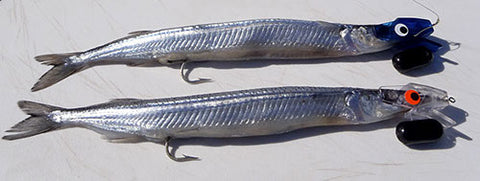
- swimming dead baits such as garfish or Pacific saury
- diving minnows rated for the intended speed and tackle
- skirted trolling lures
- a bait or lure presented deeper with a downrigger where conditions and boat setup allow
We have used Head Starts with both garfish and sauries because a straight bait and positive tow point make the spread easier to repeat. The preparation is worth doing at home. On the water, the bait only stays in the spread after it swims cleanly beside the boat.
When selecting from the Downrigger Shop trolling-lure range, use the specifications and intended swimming range of the exact lure. Set each lure from the model’s instructions and watch it beside the boat.
Let the bait or lure set the usable speed
There is no universal mackerel trolling speed. Boat size, sea state, current, lure design and bait quality all change the result. The correct speed is one where every item in the spread tracks as designed and the crew can control it safely.
Swim-test dead bait beside the boat, then watch it again after the spread settles. A spinning bait is not improved by leaving it out. Retrieve it, check head alignment, body condition and hook position, then replace it if necessary.
Diving minnows also have a working range. If one blows out or tracks to the side, inspect the lure and leader and reduce speed. Do not bend tow points casually unless the manufacturer’s tuning instructions call for it. For a systematic check of bibs, connections, hook changes and speed, use our trolling-lure troubleshooting guide.
Rig dead bait at home where possible
Good bait preparation is easier on a bench than in a moving boat. Keep bait cold, use a purpose-made bait needle and prepare only sound, straight fish. A Head Start can make the head and tow point repeatable when used with a compatible bait.
Use the detailed Head Start rigging guide for garfish and the separate Pacific saury guide for the larger bait. Those pages cover alignment, threading, safe tools and swim testing. Use purpose-made rigging tools and correctly matched components; do not cut open hooks or improvise a bait needle from wire.

Trace and hook choice must match the target, bait and local rules. Mackerel teeth can cut unsuitable leader quickly. Wire can provide bite protection but may change bait action and visibility. Mono or fluorocarbon may present differently but carries a bite-off risk. There is no universal trace answer. Use correctly rated components and accept the limitations of the chosen system.
Put a presentation below the surface when fish are holding deeper
If the sounder shows bait or fish below the wake, a downrigger can present a bait or lure at controlled depth. Set it from what the sounder shows, not from a favourite number. Allow for blowback: the weight’s actual depth is shallower than the amount of line paid out when the cable or braid angles behind the boat.
Test the release clip with the actual main line, bait and speed. The release-clip guide explains adjustment, repeatability and braid-versus-mono considerations. Keep the downrigger line clear of fishing lines and retrieve the system before sharp turns.
If a deeper bait repeatedly tangles or the boat cannot maintain a safe path, remove it. A simpler spread that fishes properly is more effective than a complicated one that occupies the crew.
Work bait and structure with controlled passes
Approach from outside the activity and plan a pass that keeps other boats predictable. Do not drive through a surface school or across another boat’s spread. Note the direction of current and wind, then repeat successful passes without cutting a tight circle over the fish.
When turning, the inside lures slow and sink while the outside lures accelerate. This can trigger a bite, but it can also tangle a poorly spaced spread. Make broad controlled turns and have a crew member watch the lines.
If a strike occurs on one side, note the lure position, depth, direction and nearby bait. Do not assume colour was the only reason. Repeat the whole useful path before replacing every lure.
Handle the strike as a crew
At the strike, the skipper should keep the boat safe and the angler should load the rod smoothly. Other crew clear lines that are likely to cross. Whether the boat continues ahead briefly or slows depends on the spread, fish direction and sea room. Agree on the routine before fishing.
Do not grab a loaded line with bare hands. Mackerel can change direction at the boat and hooks can be exposed. Use a landing tool appropriate for the fish you intend to keep, nominate one person to use it and clear the deck first.
If another line is hit but does not hook up, leave it working only if it remains clear and the crew can manage both. A second strike is useful only when it does not create a dangerous tangle.
Protect the catch and the crew
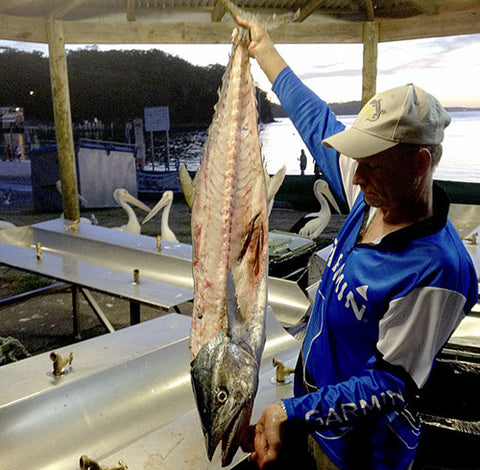
Spanish and spotted mackerel have sharp teeth and active bodies. Control the fish without placing fingers near the mouth. Use long pliers or a dehooking tool, and secure hooks before handling the catch.
Identify and measure each fish. Dispatch kept fish humanely and chill them promptly. Mackerel flesh deteriorates quickly in heat. Take only what the crew can use and release unwanted fish with minimum handling.
Bleeding and icing methods vary with facilities and food-safety practice. Plan enough ice and clean storage before the trip rather than trying to improvise after a large fish is aboard.
Troubleshoot the spread
Baits are spinning
Check body condition, head alignment, tow point and hook position. Slow down and retest. Replace a torn bait.
Diving lures are blowing out
Check for weed, leader damage, bent hardware or speed outside the lure’s design. Test it alone beside the boat.
Repeated bite-offs
Review trace material, length, hook position and the way fish are striking. Stronger main line alone does not stop a tooth cut near the lure.
Fish show deep but the spread stays high
Add one controlled deeper presentation or change to a lure that reaches the shown depth. Do not put every line deep at once.
The spread tangles on turns
Use fewer lines, increase separation and make wider turns. Recheck leader lengths and lure behaviour.
A practical starting plan
Prepare two or three sound presentations, check the forecast and current rules, then find bait before committing to a long trolling track. Swim-test every lure and bait. Run a spread the crew can clear quickly and repeat passes through the bait and water that produced the result.
Mackerel trolling is adaptable rather than mysterious. The best speed, depth and pattern are the ones that keep the day’s presentations working where the bait and fish are actually holding.
For cooler-month offshore planning beyond the mackerel season, see the Winter Game Fishing guide.