

Fred Burley · Jervis Bay
Fred took his Quintrex to Jervis Bay, where he was trolling lures and downrigging yakkas. His trip included a 130 cm / 18 kg kingfish on a 10–15 kg rod and 50 lb braid.
“Downrigging has really put a smile on my face!!”


$670.00 AUD
| /
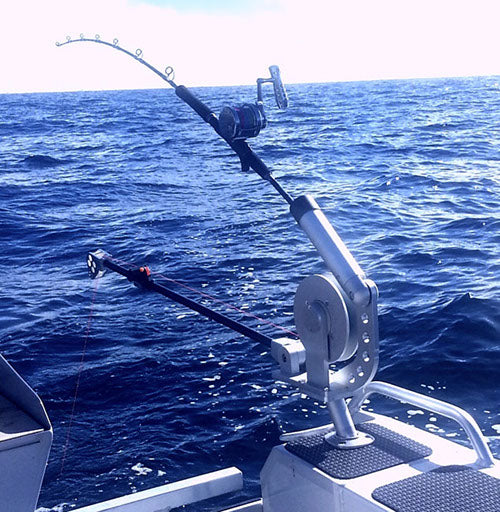
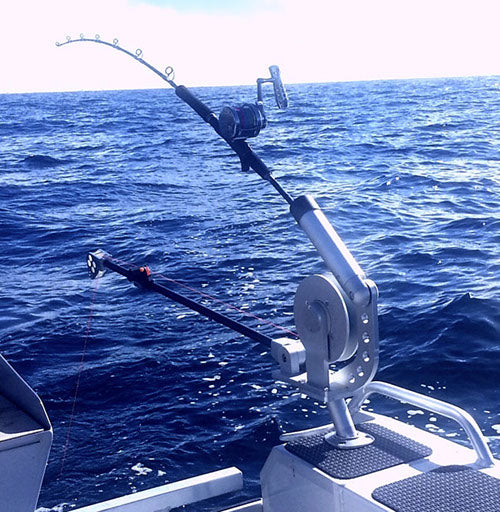
A strong, complete manual downrigger for Australian boats. A one-metre boom, heavily anodised components and Carbontex drag, supplied with the weight, release clip, counter and braid ready for your first session.
01 / Fish below the surface
Many years ago I was fishing on Bathurst Island in the Northern Territory. Each morning my guide Brett and I headed out before dawn for Spanish mackerel around the rocky headlands. They came on at first light, then the surface action faded about an hour after sunrise. I asked Brett why.
He picked up a long minnow lure and pointed out something easy to overlook: the dark back and pale belly. Many baitfish have that same colouring. Seen from above, the dark back blends into the darker water. Seen from below, the pale underside blends into the bright surface. That camouflage is called countershading.
Brett linked it to the changing light at dawn and dusk, and to the feeding pattern we were watching. He had grown up on a mackerel boat out of Wyndham, and it was the sort of explanation that made you look at fishing differently.
When the surface goes quiet, there are still fish worth targeting below it. That is where I use the sounder and downrigger together: find the bait or fish, then send a live bait or lure down to the depth they are holding. You have something much more useful to work with than another pass over the top.

02 / Built for our boats
A downrigger earns its place on the boat when it is strong, easy to work around and supplied with the tackle you need to fish. Ours combines a one-metre boom, heavily anodised components and Carbontex drag with the weight, release clip, counter and braid.
I once fished a downrigging charter on Lake Michigan from a 40-foot boat with a transom at least twelve feet across. It had shaft drive, no outboard legs to work around and plenty of room for several downriggers. The water was fresh, and the lake stayed flat all week.
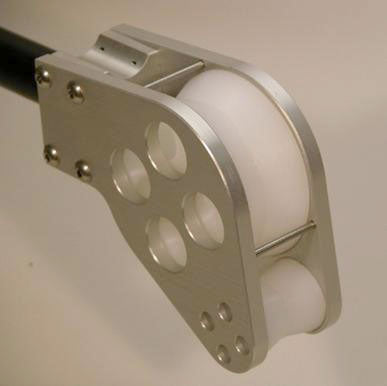
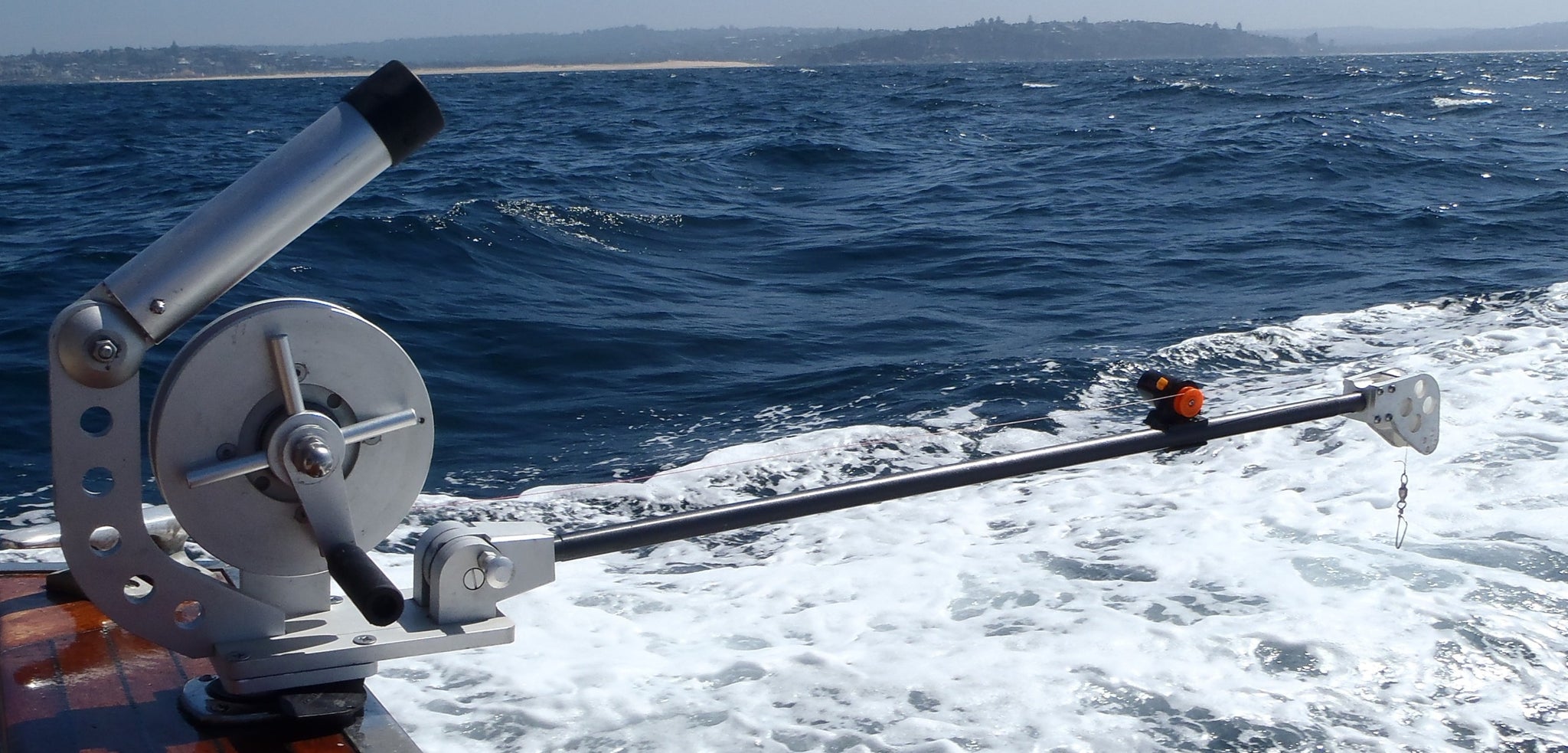
A five- or six-metre Australian boat asks different things of its gear. Saltwater, rougher conditions, an outboard at the stern and less working space make strong construction and a useful boom length count. Our one-metre boom gives you working clearance around the outboard. The swivelling boomhead runs on needle bearings and follows the direction of the weight as the boat turns.
The components are heavily anodised to help protect them in saltwater. Inside the drag are tough Carbontex washers, the same kind used in premium game reels. The drag-maintenance demonstration shows how to look after them.
I prefer braid to nylon-coated steel cable for this setup. Its smaller diameter means less line drag, so a lighter weight is easier to wind up. There is no steel cable to corrode and no cable hum. That hum is particularly noticeable in the aluminium boats so many of us fish from.
We supply the downrigger pre-spooled with 65 metres of 200 lb braid. The adjustable rod holder gives your fishing rod a place to go, and the tilting boom and removable mount make the unit easy to stow after fishing.


03 / A straightforward setup
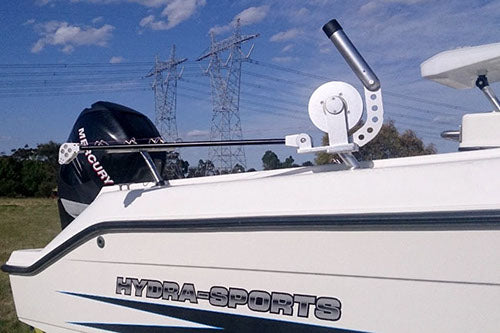
The supplied aluminium gimbal drops into a standard 37-degree metal rod holder and locks onto its cross pin. The downrigger has its own adjustable rod holder, so your fishing rod still has a place to go. The base can also be rotated to point the boom to port or starboard.
The gimbal gives you a removable mounting arrangement using your boat's rod holder. Once you have finished fishing, lift the unit out and tilt the boom for storage.

The optional detachable sliding base lets you slide the downrigger into place and secure it with a locking pin. A second fixed plate gives you a separate storage position.

Assemble the unit as shown in the setup demonstration. Seat the gimbal on the rod holder's cross pin, then check motor movement and room to work the handle and retrieve the weight. Keep the fishing line clear of the propeller as you turn.
Plan your stern layout →Support the mount, pull the holder tube away, then rotate and release it so the detent pin engages. The three photographs show the movement.
The boom tilts up and locks with a pin, making the downrigger easier to store in the boat's rod rack.


Have an unusual mounting arrangement? Send me a photo and I can help.
04 / Your first session
The weight runs on the downrigger braid. Your fishing line connects through the release, then separates when a fish strikes. You fight the fish on the rod, without the downrigger weight on your fishing line.
Attach the weight and release, fit the counter and check the connections. Keep the release within comfortable reach while you rig the fishing line.
Move slowly ahead in a straight line and run the bait or lure back behind the boat. Watch its action before lowering it. A small live bait can spin as speed increases, so let the bait tell you how fast to go. It is speed through the water that matters: current can keep a bait swimming even while the boat drifts in neutral.
When fishing for kingfish in shallow water, I like a short setback, usually around two metres behind the weight. It helps when I want to turn and go back over a promising sounder mark. It also leaves a hooked kingfish less line to reach the reef. Why give a hooked fish a head start?
Connect the fishing line through the clip, or use a rubber band as shown in the demonstration. Test that it holds the presentation while trolling and releases cleanly. See the release-clip guide for adjustment.
Back off the fishing-reel drag enough for line to leave smoothly. Reset the counter to zero. Palm the downrigger spool to prevent an overrun and ease the tensioner anticlockwise. Watch the counter as the weight descends; stop the spool and retighten the tensioner at your chosen setting.
You can often see the weight on the sounder and watch its position relative to passing fish. Over rough ground, I usually start about halfway down for kingfish. They will rise to a bait moving overhead, and keeping the weight above the reef gives you room when the bottom comes up.
Take the rod once the line releases and set the working drag. Retrieve and manage the downrigger weight as conditions allow, keeping it clear of the fish, other lines and the crew.


The counter measures line paid out. Water resistance pushes the weight back as you move, so its running depth can be shallower than the counter reading. Speed, current, weight and line drag all affect this blowback. Use the Downrigger Depth Calculator for an estimate, then watch the sounder to see where the weight is running.
Keep learning: complete downrigging guide · live-bait rigging · how downrigging works.
05 / On the water
Fred took his Quintrex to Jervis Bay, where he was trolling lures and downrigging yakkas. His trip included a 130 cm / 18 kg kingfish on a 10–15 kg rod and 50 lb braid.
“Downrigging has really put a smile on my face!!”

Brad and his mate fished one downrigged presentation alongside three surface rigs. The only marlin they raised took the downrigged presentation, and they released it.
“It was the 1st time we had used a Downrigger so was all new to us but found it very effective”

After losing four fish the previous week, Chris went back with heavier tackle and 150 lb braid. This time he came home with two kingfish.
“Caught these 2 fish in less than 15m of water in close to the cliffs, using yr downrigger with live yakkas.”

Tony sent in this 17 kg mahi after his Whitsundays competition trip.
“We won the heaviest other game fish & runner up highest combined point score.”
Grant took a customised pair of our downriggers to South West Rocks. His trip report described trolling X-Raps for tuna, including a 7 kg yellowfin, and boating a 115 cm Spanish mackerel.
“Not a bad day for our first day fishing at SWR 15 or so fish in the boat and a good feed of fish for the night.”

A customer fishing off Noosa described using both manual and electric downriggers with rigged garfish. For his shallower presentations, he wrote:
“I use the manual downrigger with 3lb weight for up to 5m down”
His solo trip also produced a wahoo and three stripies.

One customer started with a live bait on the downrigger and another on the surface. Both hooked up within three minutes. After landing those fish, the downrigger produced another Spanish mackerel.
“We ended up with 5 fish for the morning and 3 from the downrigger.”
The next day the water had changed and the fishing was harder. He reported a shark mackerel and two yellowfin tuna, all on the downrigger.

06 / See it done
From your first setup to a fish on the line. Choose a demonstration and press Play, or open it on YouTube.
07 / Useful answers
Yes. You lower the weight using the spool tensioner and wind it back up by hand. There is no electric motor or battery connection.
The video library includes a demonstration of drag maintenance. For parts or help identifying your model, get in touch.
Our shipping policy and returns policy have the details, or contact us about your order.
Get the complete downrigger kit, with the tackle to start fishing and practical help from someone who uses it.